

Sales Onboarding Checklist: 12-Step Plan
Apr 24, 2026Sales Onboarding Checklist: 12 Steps for New Reps
Want to speed up your sales team's productivity? Here's how: Onboarding new sales reps can take months, costing companies $100,000–$240,000 per hire. With a structured 12-step process, you can cut ramp-up time by 50%, reduce turnover, and increase revenue per rep by 15%.
Key Takeaways:
-
Average ramp-up: 5.3 months for AEs, 3.6 months for SDRs.
-
Structured programs improve retention by 58% and quota attainment by 73%.
-
Focus on microlearning, gamification, and a clear 30-60-90 day framework.
Steps Include:
-
Pre-board tasks like tech setup and paperwork.
-
Use self-paced programs like The Condor Club for training.
-
Dive into product knowledge with gamified quizzes.
-
Practice sales processes using role-play and AI simulations.
-
Master sales tools like CRMs and engagement platforms.
-
Shadow experienced reps and set 30-60-90 day goals.
-
Use leaderboards and rewards to track progress.
Results: Faster ramp-up, higher retention, and better quota achievement.
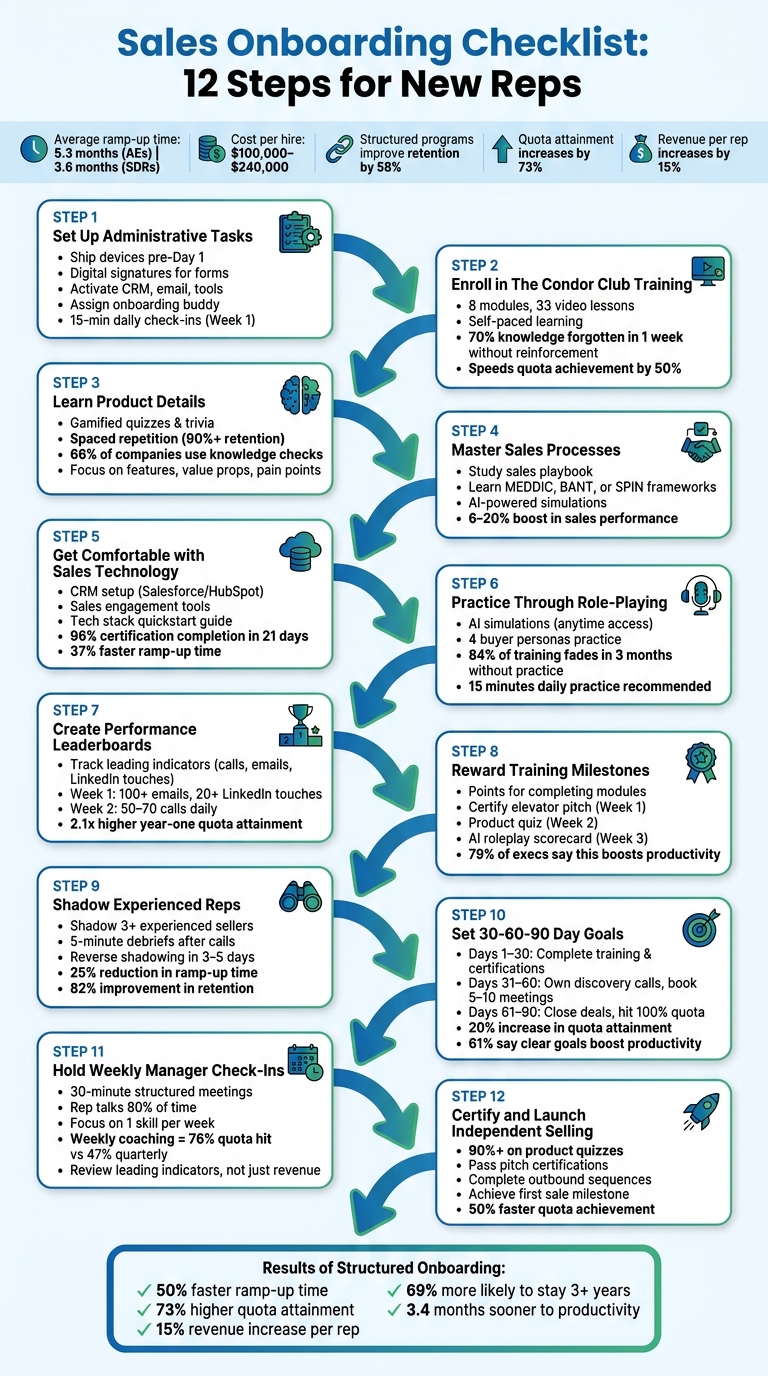
12-Step Sales Onboarding Checklist for New Reps
How to Build Rep Onboarding That Actually Sticks
Step 1: Set Up Administrative Tasks
Getting the administrative side of things in order is key to a smooth onboarding process. Don’t let Day 1 get bogged down with paperwork - reps who are ready to hit the ground running can gain a 1–2 week advantage. This is especially important when you consider that 20% of new sales hires leave within their first 45 days, often due to a poor start. The steps below help ensure Day 1 is all about connection, not logistics.
Start by handling pre-boarding tasks ahead of time. Ship out devices and use digital signatures for forms like I-9, W-4, and benefits enrollment. This way, Day 1 can focus on introducing your company’s culture and building relationships, not filling out forms.
"If they're spending Day 1 filling out forms, you're already behind".
Next, clarify compensation details early. Schedule a 30-minute meeting on Day 1 to explain everything - OTE, base salary, commission, accelerators, and ramp draw structures.
"Ambiguity about compensation is a retention risk and a motivation risk simultaneously".
Technology setup is another area to streamline. Make sure CRM, email, and communication tools are fully activated before Day 1. Companies with strong onboarding processes are 6.3 times more likely to set new sales hires up for success, and eliminating tech-related hurdles is a big part of that.
Finally, assign an onboarding buddy - someone who’s a high-performing peer - and schedule daily 15-minute check-ins for the first week. These small efforts foster a sense of support and show new hires that your organization values their time and success from the very start.
Step 2: Enroll in The Condor Club Training
After wrapping up administrative tasks, the next priority is to get new sales reps into a structured training program. The Condor Club offers a self-paced program with 8 modules and 33 video lessons designed to establish a strong sales foundation. Instead of cramming everything into the first week, this "everboarding" approach spreads learning out over time, making it easier to absorb and retain.
Why does this format work so well? Because most B2B sales reps forget 70% of what they learn within a week if there’s no reinforcement. By using short, focused lessons, the program combats this forgetting curve. Studies show that revisiting an idea six times with breaks can improve retention to over 90%. This method ensures reps don’t just learn - they remember.
Another big plus is that the training evolves alongside your business. Lifetime updates mean the content stays relevant as your products and market shift. Reps can revisit modules months later to refresh their skills or learn about new features, transforming onboarding into an ongoing resource rather than a one-time activity.
The benefits of structured onboarding are clear: it can speed up quota achievement by 50% and increase quota attainment by 20%. To maximize these advantages, it’s smart to enroll new reps in training during pre-boarding - before their official start date - so they can hit the ground running.
The program also includes practical tools like downloadable action worksheets and a tech stack quickstart guide, helping reps apply what they’ve learned right away. Pricing is flexible, with individual access available for $349 or an enterprise package at $20,000. The enterprise option includes 50 licenses, virtual kickoff sessions, and manager training, making it scalable as your team grows.
Step 3: Learn Product Details
After completing the initial training modules, the next step is for sales reps to dive deep into the product details. To make this process more engaging, tools like gamified quizzes and trivia can be incredibly effective. At The Condor Club, these interactive methods turn what could be a passive learning experience into an active and enjoyable one. This approach helps reps quickly grasp technical features, understand value propositions, and identify customer pain points.
Using gamified quizzes with techniques like spaced repetition can significantly enhance memory retention - boosting it to over 90%. It's worth noting that 66% of companies with strong onboarding programs use regular knowledge checks to ensure their reps thoroughly understand the product before interacting with customers.
These quizzes do more than just improve retention; they also pinpoint areas where reps might be struggling. For example, if a rep has difficulty with a specific product feature during a trivia session, managers can step in with focused coaching to address the issue. This proactive approach ensures that knowledge gaps are closed before they affect customer interactions. Gamification elements like points, badges, and leaderboards add a fun, competitive edge, which resonates well with the naturally driven nature of sales professionals.
"When salespeople understand the product inside and out, they can offer tailored solutions that address customer pain points, leading to higher conversion rates." - Robert Boesel, Mural
To maximize the effectiveness of this training, it's better to spread quizzes out over the first 30 days rather than cramming them into the first week. Focus on scenarios that challenge reps to solve customer problems using specific product features. This prepares them for real-world applications and ensures they’re ready to tackle customer challenges with confidence.
Step 4: Master Sales Processes
Once sales reps have a solid grasp of the product, the next step is learning a structured sales process. This involves understanding your company's standardized B2B sales playbook. Without a clear framework, reps might rely on improvisation, which can lead to inconsistent messaging and missed opportunities. A well-defined process keeps everyone aligned and connects product knowledge with effective selling techniques.
A comprehensive sales playbook guides reps through the entire customer journey - from prospecting and discovery to pitching, addressing objections, and closing deals. It also outlines your team’s sales methodology, often using established frameworks like MEDDIC (Metrics, Economic Buyer, Decision Criteria, Decision Process, Identify Pain, Champion), BANT (Budget, Authority, Need, Timeline), or SPIN (Situation, Problem, Implication, Need-Payoff). These frameworks provide a consistent, reliable approach for moving prospects through the sales funnel. In fact, companies using sales enablement tools such as playbooks and battlecards report a 6% to 20% boost in sales performance.
"A sales process is the method by which your reps move prospects toward closing." - Kristen Baker, HubSpot
However, mastering these concepts isn’t just about theory - it’s about practice. Tools like the Condor Club’s AI-powered simulations allow new reps to rehearse key skills, such as conducting discovery calls, delivering demos, and handling objections. These simulations use realistic, adaptive scenarios to provide instant AI feedback and detailed scorecards [21,4]. This hands-on, low-pressure environment helps build confidence before reps interact with actual prospects.
Step 5: Get Comfortable with Sales Technology
In today’s B2B sales landscape, being proficient with sales technology is non-negotiable. New sales reps must quickly get up to speed on Customer Relationship Management (CRM) systems like Salesforce or HubSpot. These platforms act as the core hub for managing leads, deals, and customer interactions. But CRMs are just the beginning. Reps also need to work with Sales Engagement, Intelligence, roleplay, and conversation tools to streamline their workflows. The challenge isn’t just learning these tools - it’s integrating them into daily routines effectively.
To make this transition smoother, reps can use a tech stack quickstart guide to understand which tools are essential at different sales stages. This guide also helps configure CRM fields in line with the company’s sales methodologies. While video tutorials are helpful, they’re no substitute for real-world practice. Reps should dive into hands-on tasks like creating sample deals, logging activities, and simulating workflows to build familiarity with these tools. This kind of hands-on learning is crucial since these platforms are the backbone of the structured sales processes covered in later steps.
"Good data hygiene starts on Day 5, not Day 50." - Enboarder
Gamification can make tech training more engaging and effective. Instead of treating it as a box to check off, companies can introduce threshold scores for technology certifications to ensure reps have genuinely mastered the tools before interacting with prospects. Gamified rewards, leaderboards, and benchmarking top performers encourage adoption and create a sense of competition and achievement. This approach works: companies with structured training programs report a 96% certification completion rate within the first 21 days of onboarding. Such programs also lead to impressive results, including 73% higher quota attainment rates and a ramp-up time that’s 37% faster, with new hires becoming productive 3.4 months sooner.
This hands-on immersion in sales technology sets the stage for the interactive, practical training in the next steps. By mastering these tools early, reps build the confidence and skills they’ll need to excel in real-world sales scenarios.
Step 6: Practice Through Role-Playing
Once you've got a handle on sales tools and processes, the next step is putting that knowledge to work. It's one thing to know your product and sales strategy; it's a whole other challenge to apply it in real conversations. Role-playing bridges that gap, turning theoretical understanding into practical skills. It helps sales reps develop instincts for handling discovery calls, overcoming objections, and negotiating pricing. Without consistent practice, studies show that 84% of sales training knowledge fades within three months.
The Condor Club's AI simulations offer a game-changing way to practice. They provide a risk-free environment where new reps can refine their client interaction skills without jeopardizing actual deals. Unlike traditional role-playing, which often requires scheduling, AI simulations are available anytime - whether it's early morning, during lunch, or late at night. These simulations are designed to mimic real buyer personas - Driver, Analytical, Expressive, and Amiable - helping reps adapt their communication style on the spot. Plus, every session is scored against your company's sales framework (like SPIN, MEDDIC, or a custom method), with instant feedback provided through detailed scorecards and transcripts.
The key is to start small and gradually increase the complexity. For example:
-
Week 1: Focus on a simple 60-second elevator pitch.
-
Week 2: Shift to discovery calls aimed at uncovering client pain points.
-
Week 3: Dive into more advanced objection-handling scenarios.
-
By Month 2: Reps should be confidently practicing complex negotiations and pricing discussions.
Repetition is crucial here. Practicing a scenario once is just the beginning. Reps need to repeat each one multiple times until their responses feel natural and align with performance standards.
"Roleplaying in the sales onboarding process bridges the gap between knowledge and performance." – Wayground
To make the most of these tools, encourage reps to dedicate 15 minutes daily to AI practice. After each session, they should review their scorecards and retry the scenario to address any weak points. This consistent feedback loop helps reps learn faster than they would through occasional manager-led sessions. By the end of this phase, they'll have built a strong foundation for the rest of their onboarding journey.
Step 7: Create Performance Leaderboards
After practicing through role-playing, it’s time to channel that competitive energy into measurable results using leaderboards. These tools turn onboarding into a dynamic, competitive process that encourages daily performance. The trick? Focus on the right metrics during those crucial first 30 days. This is when forming habits matters more than closing deals.
"The first 30 days aren't about quota - they're about building muscle memory for the sales process." – Optifai
In the early stages, leaderboards should track leading indicators like daily outbound calls, emails sent, LinkedIn interactions, and total tasks completed. For instance, Week 1 might focus on hitting 100+ emails and 20+ LinkedIn touches. By Week 2, the focus could shift to making 50–70 calls daily while monitoring connect rates [12,29]. These activity-based goals help new reps build confidence and momentum without the added stress of revenue targets. This foundation is essential for leveraging tools like The Condor Club’s integrated tracking features.
The Condor Club simplifies leaderboard management with real-time performance tracking. It automatically ranks reps based on customizable KPIs, such as calls made, meetings scheduled, or pipeline value. You can display these leaderboards on office TV dashboards or sync them with Slack to keep performance visible throughout the day. With 50 licenses included in the enterprise package, entire onboarding cohorts can compete while managers monitor progress through automated weekly reports.
To make leaderboards even more effective, consider including milestone-based metrics. Track things like time to first logged activity, time to first meeting booked, or time to first opportunity created [12,35]. These "time-to" metrics highlight reps who might be struggling with technical issues or confidence early on, giving you a chance to address problems before they escalate. Companies that emphasize process mastery over initial revenue generation report 2.1x higher year-one quota attainment.
Salespeople are naturally competitive, and 79% of sales executives say that setting new performance targets is a key productivity driver. By making performance transparent and celebrating small victories - like achieving 95% CRM accuracy or completing five customer conversations by Day 10 - you create an environment where reps push themselves harder than any manager could. Tracking these daily metrics not only builds momentum but also fosters a culture of growth. With performance metrics clearly visible, new reps are ready to tackle the next phase of onboarding.
Step 8: Reward Training Milestones
Once you've established visibility with leaderboards, it's time to energize your team by introducing rewards for key training achievements. Recognizing behaviors that drive progress - especially during the critical first 90 days - turns passive learning into an interactive, gamified experience. Assigning points for hitting training milestones not only keeps new sales reps engaged but also taps into their natural competitive drive. In fact, 79% of sales executives say this approach boosts overall productivity.
In the first 30 days, focus on rewarding habits and processes rather than revenue outcomes. For example, you can incentivize reps for completing product knowledge modules or scoring well on discovery call role-plays. This milestone-based strategy addresses the challenge of knowledge retention - B2B reps typically lose 70% of new information weekly - by reinforcing learning and ensuring steady progress. Companies with structured onboarding programs report that new reps hit their sales quotas 50% faster than those without.
"In the first 30 days, reward habits and learning velocity. Do not over-index on results yet. Focus on call quality, structure, and consistency." – Julien Heissat, CEO, muchbetter.ai
To make milestones actionable, tools like The Condor Club's downloadable worksheets can help track progress and turn goals into clear, achievable steps. For instance, set checkpoints such as certifying a 60-second elevator pitch by the end of Week 1, passing a 20-question product knowledge quiz by Week 2, or completing an AI roleplay scorecard by Week 3. Each milestone earns points that feed into the leaderboard system, creating a feedback loop that highlights skill gaps before reps engage with real prospects.
Celebrate these achievements publicly. Acknowledge certifications during team huddles and showcase top scores on dashboards. Public recognition not only reinforces key sales values but also sets clear expectations for success. Companies with strong onboarding programs see a 15% increase in revenue per rep and an 82% improvement in employee retention. By tracking and rewarding clear milestones, you help new reps build confidence and lay the groundwork for sustained success.
Step 9: Shadow Experienced Reps
Pairing new sales reps with seasoned team members helps bridge the gap between theory and practice. Shadowing allows trainees to see how concepts from training - like pacing, discovery questions, and handling objections - play out in real conversations. This hands-on approach can cut ramp-up time by 25%.
Encourage new reps to shadow at least three experienced sellers. This exposes them to different call styles and techniques, offering a broader understanding of what works in various scenarios. To make these sessions effective, use role-play debrief worksheets to capture observations. Before each call, set clear expectations for what the trainee should focus on, whether it’s discovery methods, CRM navigation, or addressing pricing objections. Afterward, conduct a quick five-minute debrief to solidify learnings. Ask questions like: What went well? What could have been done differently? What was unclear?
"The debrief is where observation converts to understanding." – Prospeo Team
After initial shadowing, move to reverse shadowing. In this phase, the trainee takes the lead on the call while the mentor observes and provides feedback. This transition should happen within three to five days. Companies that include structured shadowing in their onboarding programs see big benefits - new hire retention improves by 82%, and productivity increases by more than 70%.
Step 10: Set 30-60-90 Day Goals
After laying the groundwork with training and shadowing, the next step is setting clear, actionable milestones through a 30-60-90 day plan. This structured approach offers new sales reps a clear path forward while helping managers spot and address performance gaps early on. And it’s effective: 61% of sales professionals say that having clear expectations and goals significantly boosts productivity. Companies using structured playbooks have even managed to cut SDR ramp times from the typical 4–6 months down to just 45–60 days.
Here’s how the timeline typically breaks down:
-
Days 1–30: Focus on completing training modules, shadowing calls, and passing certifications.
-
Days 31–60: Take ownership of discovery calls, book 5–10 qualified meetings, and fine-tune objection-handling skills.
-
Days 61–90: Close deals, hit 100% of the ramped quota, and manage the entire sales cycle independently.
This method has real-world results. For instance, a major telecom company saw a 20% increase in quota attainment by implementing a structured 30-60-90 day plan.
The Power of SMART Goals
Goals should always be SMART - Specific, Measurable, Achievable, Relevant, and Time-bound. This framework reinforces the habits and skills introduced during training. For example, a SMART goal might be: “Complete all 8 Condor Club training modules and pass certification quizzes”. Early on, focus rewards on learning progress and strong CRM practices, rather than immediate revenue results.
Julien Heissat, CEO of muchbetter.ai, puts it best:
"The purpose of sales onboarding is not to make a rep 'know everything.' The purpose is to help the rep become productive safely and consistently, with the right habits and standards".
Tracking Progress and Adjusting Goals
Use tools like The Condor Club’s training platform to monitor progress. Track metrics such as training completion rates, quiz scores, and shadowed call performance, linking them to later outcomes like qualified opportunities and closed deals. This creates a feedback loop where early data informs real-world targets, allowing you to adjust expectations as needed.
Weekly one-on-one check-ins are another vital piece of the puzzle. These meetings provide an opportunity to review progress, address challenges, and make adjustments. If a rep is falling behind by day 30, intervene immediately with coaching or revised goals. This consistent review process ensures reps are on track to confidently take full ownership of the sales cycle.
Step 11: Hold Weekly Manager Check-Ins
Weekly manager check-ins are a key part of keeping new reps on track after their initial training. These one-on-one meetings between managers and new hires provide consistent support, tackle challenges early, and reinforce the skills developed during onboarding. The impact is clear: teams that receive weekly coaching hit 76% of their quotas, compared to just 47% for those coached quarterly or less.
The structure of these check-ins matters. Keep them focused and efficient - 30 minutes is ideal. Use this time to review progress on goals, discuss active deals, assess pipeline health, and identify one or two skill gaps. From there, set 2–3 actionable tasks for the rep to work on. This approach ties back to the 30-60-90 day framework mentioned earlier. Resources like the Condor Club's manager training tools offer standardized agendas and performance rubrics to guide these conversations. Managers can even use rubrics to objectively score skills like discovery depth or handling objections on a 1–5 scale.
During these sessions, make sure the rep does most of the talking - around 80%. Instead of giving step-by-step instructions, ask open-ended questions like, "What’s our next step for this deal?" This encourages reps to think critically and develop problem-solving skills. Use the remaining 20% of the time to give focused feedback and guide them toward solutions. Bret Larsen, CEO of GetChief, sums it up perfectly:
"Stop being the hero who closes deals. Start being the coach who develops people who close deals".
Each session should focus on improving one core skill at a time. For example, Week 2 might center on refining discovery questions, while Week 3 could target perfecting demos. Revisit role-playing scenarios as part of the session to reinforce these skills.
Accountability is crucial, so start each meeting by reviewing the previous week’s action items. Pay attention to leading indicators like customer conversations, demos delivered, and CRM accuracy - not just revenue numbers. For example, one company implemented daily CRM prompts and structured check-ins, which cut ramp time by 40% and increased revenue per rep by $89,000 over six months. Even better, all new reps stayed beyond six months, compared to just 33% under their old system. These check-ins aren’t just about short-term results - they set the foundation for confident, independent sellers in the long run.
Step 12: Certify and Launch Independent Selling
Certification is the bridge between training and independent selling. Before interacting with real prospects, new reps must prove they’ve mastered the basics. The Condor Club’s certification process ensures every rep is fully prepared to represent the company with confidence and competence.
"Certification before customer interaction guarantees a baseline of quality and confidence for every new hire".
This step eliminates the risk of reps using live prospects as practice, solidifying their readiness to sell effectively. Certification marks the end of training and the beginning of gradual, independent selling.
To certify reps, evaluate them across four key areas: knowledge, skills, activity, and results:
-
Knowledge: Reps should score 90% or higher on product and market quizzes, demonstrating their understanding of product features, buyer personas, and the competition.
-
Skills: Assess their abilities through pitch certifications and mock demos, using standardized scorecards to measure performance.
-
Activity: Set benchmarks like completing outbound sequences or maintaining clean CRM data.
-
Results: Look for outcome-based milestones, such as achieving a first sale or building a qualified pipeline, to confirm they’re ready for live selling.
Start with controlled sales scenarios where managers listen silently and provide immediate feedback. Over time, shift from direct guidance to coaching and deal strategy discussions.
But certification isn’t the end - it’s just the beginning. Reps need ongoing support to continue improving. Use training resources like leaderboards and call libraries, and stick to weekly check-ins and role-playing sessions. One-on-one meetings should focus on pipeline reviews and skill-building, not just administrative updates. Regular quizzes and skill refreshers also help combat the effects of forgetting.
Why does this matter? Companies with structured onboarding programs see new reps hit their quotas 50% faster and enjoy a 15% revenue boost per rep. These results underscore the importance of a strong certification process combined with ongoing development.
Conclusion
A well-structured 12-step onboarding checklist can drastically improve how quickly new B2B sales reps become productive. The numbers back it up: companies with effective onboarding programs see 73% higher quota attainment rates and enable reps to hit their quotas 50% faster. On top of that, new hires in top-tier programs become productive 3.4 months sooner than those in less effective ones. Considering the average ramp-up time is 5.3 months for an Account Executive and 3.6 months for an SDR, this time savings is a game-changer.
The financial benefits are just as striking. Companies with strong onboarding processes report a 15% increase in revenue per rep, while retention rates soar - well-onboarded reps are 69% more likely to stay for at least three years. This is especially important when the cost of recruiting, hiring, and onboarding a single sales rep can climb to $100,000.
The Condor Club's approach directly tackles a major issue: 62% of businesses feel their onboarding processes are falling short. By integrating structured training, role-playing exercises, and clear milestones with tools like performance leaderboards and certification programs, new hires can develop critical skills without the overwhelm that leads to 70% of training being forgotten within a week.
"A great sales rep can fail with poor onboarding, while a good rep can become great with a world-class program." - Hyperbound
This checklist does more than just shorten ramp times - it builds confidence, ensures consistent messaging, and sets the stage for long-term success. With a focus on mastering product knowledge, practicing real-world scenarios, and receiving ongoing support through weekly check-ins and shadowing, new reps don’t just get through their first 90 days - they excel.
FAQs
What should I measure to prove onboarding is working?
Tracking the right metrics is key to understanding how effective your onboarding process really is. Focus on time-to-productivity, retention and turnover rates, and sales performance.
-
Time-to-productivity measures how quickly new hires start making meaningful contributions.
-
Retention and turnover rates reveal how well your onboarding supports long-term employee engagement.
-
Sales performance metrics - like quota attainment, ramp-up time, and early sales activity - offer insight into how prepared new sales team members are to hit the ground running.
By keeping an eye on these indicators, you’ll not only get a clear picture of what’s working but also uncover areas that could use some fine-tuning.
How do I tailor the 30-60-90 plan for SDRs vs. AEs?
When creating a 30-60-90 plan, it's important to align it with the specific responsibilities of Sales Development Representatives (SDRs) and Account Executives (AEs). Each role has distinct focuses, so their onboarding plans should reflect those differences.
For SDRs, the early stages should emphasize skills like prospecting, qualifying leads, and outreach techniques. These are the building blocks of their role, so activities should center around mastering these foundational tasks.
On the other hand, AEs need to concentrate on pipeline creation, moving deals through the sales process, and closing opportunities. Their plan should gradually prepare them to handle the full sales cycle, with an emphasis on deal progression and sealing the deal by the 90-day mark.
By customizing onboarding activities to match these core functions, SDRs can develop a strong base in lead generation, while AEs can focus on managing and closing deals effectively. This tailored approach ensures both roles are set up for success within their unique responsibilities.
When is a new rep ready to sell without supervision?
A new sales representative is usually prepared to start selling independently after finishing a structured onboarding program, which typically takes between 30 and 90 days. During this period, they focus on building expertise in product knowledge, sales techniques, and company procedures. Their readiness is often measured by their ability to confidently and effectively manage sales responsibilities - something that can become evident as early as the first 30 days or by the conclusion of the 90-day program.
Lorem ipsum dolor sit amet, consectetur adipiscing elit. Cras sed sapien quam. Sed dapibus est id enim facilisis, at posuere turpis adipiscing. Quisque sit amet dui dui.
Stay connected with news and updates!
Join our mailing list to receive the latest news and updates from our team.
Don't worry, your information will not be shared.
We hate SPAM. We will never sell your information, for any reason.
